TRADUCCIÓN
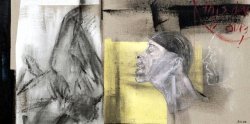
Leon Golub
Hung, 1996
Acrílico sobre lienzo
56x112 cm.
Coinciding with the exhibition which the MNCARS is devoting to Leon Golub, the Pilar Serra gallery has wished to pay a personal tribute to an iconic couple within the art of the 20th century, that made up of the already mentioned Leon Golub and the artist Nancy Spero, both of whom understood art as the obligatory platform for denouncing political, social and sexual abuses associated with power in our (their) contemporary era.
Children of a generation that experienced in full the greatest horrors of the 20th century (2nd World War, Vietnam and military dictatorships), Nancy Spero (1926-2009) and Leon Golub (1922-2004) understood their work as a fight, as space destined to raising one’s voice and taking combative ideas for change over to other spheres, a change in a search for equality (sexual, social, racial, political) and for freedom. Highlighting the artistic importance of these two personalities within the 20th century and the prevailing contemporariness of their messages (reappearing with great strength during the Iraq war and the events occurred in Abu Ghraib) the Pilar Serra gallery proposes a dialogue among their works, a selection that ranges from some large canvases from Golub (from the '60s influenced by old sculptures to the most up to date ones of the '90s) up to the well-known paper friezes by Spero linked with classical female figures and their symbolic contents.
Spero and Golub first met during their studies in the School of the Art Institute of Chicago at the end of the ‘40s and were inseparable from then on. Their long life together led them to developing an artistic corpus with a clear common theme, that of denouncing all the atrocities carried out by power in its search for political and human control, along with re-updating the idea that art, as well as its aesthetic and optical function, possesses an earlier ethical purpose: that of being pronounced with all its empathic force and of serving as a vehicle for communication, as an obligatory platform for giving visibility and promoting change, overturning the footprints of authority that violate human rights and promote inequalities.
Although it is true that these ideas – the humanistic function of art and human corruptibility – are a continuous undertone in both their careers, each one evidences a personal way of seeing and therefore of choosing the topics and of showing them. While Golub is closer to a narrative and pictorial representation of violence and oppression in socio-political relations, and the effects of power taking the human body as a sign of identity; Spero above all tackles the topic of sexual and female equality through paper (she rejects painting on canvas due to its historically masculine link in art) which becomes converted into the medium for a language of her own, halfway between the literary and the pictorial, which looks to involve the viewer physically and mentally, on occasions converting them into a reader and interpreter of a new code.
We can perhaps end with a quote from Golub in order to represent this common conducting thread of what they sought and understood from art: "Too many people have a sort of protective attitude about art. You know, Don't touch. It's valuable. I'm trying to be more in your face, like when you walk down the street and suddenly you encounter a situation. I'm trying to invite you into scenes where you might not want to be invited in."
ÚLTIMAS NOTICIAS EN PORTADA


MANTENIDO POR

© nexo5.com :: All rights reserved :: Since Sep 20, 2006 -