Magacín digital de cultura contemporánea
AÑO 21 - Lunes, 26 de Octubre de 2026 a las 14:25:47 - Madrid (Spain-Europe)
TRADUCCIÓN
Laurent Zylberman shows his works in Spain for first time
© Laurent Zylberman
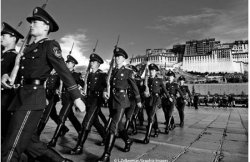
Repetición del desfile militar del ejército Popular de Liberación APL delante del palacio de Potala para celebrar la Fiesta nacional (Liberación comunista de China en octubre de 1949). Lhassa, Tíbet, China. Lhassa, Xizang, Tíbet, China. 30/09/2008
Repetición del desfile militar del ejército Popular de Liberación APL delante del palacio de Potala para celebrar la Fiesta nacional (Liberación comunista de China en octubre de 1949). Lhassa, Tíbet, China. Lhassa, Xizang, Tíbet, China. 30/09/2008
Idioma: English
nexo5.com
Between September and October 2008, Laurent Zylberman, photographer and Éric Meyer, a journalist, were among the few westerners since the riots of March 2008, authorized to do a report on the Tibet Autonomous Region. They tried to draw a nuanced portrait of a country where two cultures confront and often clash.
Travelling by the new railroad linking Beijing to Lhasa, they sometimes trick to pull on the sly, usually in the evening, some pictures or a few secrets, sometimes meekly followed the marked route that had been granted, and inviting us to a dual approach in which the second is perhaps not the least interesting. The immediate impression given off by the images of Laurent Zylberman is a region under surveillance: the ubiquity with silhouettes of police and military patrols in the streets attest, a region invaded every day by thousands of immigrant Han draining into the stations, pioneering the new Wild West, seeking their fortune by their overwhelming numbers and demographics of the country. But over the visits, a different vision is emerging: that of a country in deep and brutal economic transformation that challenges a thousand-year-old lifestyle and the fragile environmental balance of a high plateau so far populated by nomads. Irrigation canals, roads, hydropower, mining, airports but also schools, universities, hospitals reflect the colossal Chinese investment to a region of Tibet modern and profitable. In town, the shops full of clothes made in China, department stores align their battalions of uniformed vendors, nightclubs attract Tibetan youth come to listen to Western music. All this shows the desire to woo the official authorities who rely on the influx of consumer goods and even show some tolerance for religious practices or the teaching of Tibetan culture.
The symbolic power of black and white photographs of Laurent Zylberman is that they condense, often in a single image, clashes between two systems of values carried by two communities where relationships between misunderstanding, mistrust, often disregard . Unexpected encounters, sometimes funny, collisions are temporal manifestations of friction between these two cultures, a materialistic, aggressive-oriented technical efficiency, the conquest of new wealth, the other primarily spiritual, faithful to a conception of man´s place in a cyclical time and immutable cosmic order.
Travelling by the new railroad linking Beijing to Lhasa, they sometimes trick to pull on the sly, usually in the evening, some pictures or a few secrets, sometimes meekly followed the marked route that had been granted, and inviting us to a dual approach in which the second is perhaps not the least interesting. The immediate impression given off by the images of Laurent Zylberman is a region under surveillance: the ubiquity with silhouettes of police and military patrols in the streets attest, a region invaded every day by thousands of immigrant Han draining into the stations, pioneering the new Wild West, seeking their fortune by their overwhelming numbers and demographics of the country. But over the visits, a different vision is emerging: that of a country in deep and brutal economic transformation that challenges a thousand-year-old lifestyle and the fragile environmental balance of a high plateau so far populated by nomads. Irrigation canals, roads, hydropower, mining, airports but also schools, universities, hospitals reflect the colossal Chinese investment to a region of Tibet modern and profitable. In town, the shops full of clothes made in China, department stores align their battalions of uniformed vendors, nightclubs attract Tibetan youth come to listen to Western music. All this shows the desire to woo the official authorities who rely on the influx of consumer goods and even show some tolerance for religious practices or the teaching of Tibetan culture.
The symbolic power of black and white photographs of Laurent Zylberman is that they condense, often in a single image, clashes between two systems of values carried by two communities where relationships between misunderstanding, mistrust, often disregard . Unexpected encounters, sometimes funny, collisions are temporal manifestations of friction between these two cultures, a materialistic, aggressive-oriented technical efficiency, the conquest of new wealth, the other primarily spiritual, faithful to a conception of man´s place in a cyclical time and immutable cosmic order.
NOTICIA ORIGINAL
ÚLTIMAS NOTICIAS EN PORTADA


MANTENIDO POR

© nexo5.com :: All rights reserved :: Since Sep 20, 2006 -