Magacín digital de cultura contemporánea
AÑO 21 - Viernes, 9 de Octubre de 2026 a las 10:00:07 - Madrid (Spain-Europe)
TRADUCCIÓN
'Ráfols-Casamada. Paintings 1950-2005' at the Galería Danubiana of Bratislava
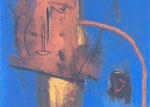
© Ráfols-Casamada
Tensió
Cortesía SEACEX
Tensió
Cortesía SEACEX
Idioma: English
nexo5.com
As one of Catalonia's leading contemporary artists, the multi-talented Albert Ráfols-Casamada (Barcelona, 1923) is a legend in our time, with indisputable presence on the international stage. This is not only due to his extensive background in painting, (in which he turned professional in 1946), but also as a result of his literary works and poems. His book entitled Dietario and his complete works of poetry are two major pieces that are key to understanding Catalan aesthetic modernity, which enjoys a strong presence in Hispanic arts.
After abandoning his career as an architect in 1948, Albert Ráfols-Casamada enrolled at the Academia Baixas, where he was to meet his future wife, painter María Girona. Prior to this, he had been a member of the Els Vuit group, with which he exhibited his works for the first time in Barcelona in 1946. The following year saw his first individual offering on display at Barcelona's Galería Pictórica. He was later awarded a scholarship to study in Paris, where he lived for three years. He then travelled to the Netherlands and England with a view to expanding his visual training; a process that was to bring him closer to the aesthetics of informalism and abstract art.
Apart from his painting, Ráfols-Casamada has also played an important educational role as a teacher at Barcelona's Elisava and EINA design schools, which are given over primarily to graphic art forms. He holds a place on the board of trustees of the Joan Miró Foundation and has received numerous accolades over the years, including the Medalla de las Bellas Artes (prestigious Fine Arts award from the Spanish government).
After starting out with a distinctly figurative style, Ráfols-Casamada's artwork then became more abstract and was characterised by his play of colours and the emergence of a certain geometric structuring. This lasted until the end of the fifties and the onset of the sixties, when his use of colours gradually became more austere as whites took centre stage and his first collages began to appear.
He later went on to reintroduce certain essentialised chromatic elements into his work, which were both symbolic and aesthetic and served to balance the work of the artist, who, already in his eighties, continues to work and fascinate in equal measure.
After abandoning his career as an architect in 1948, Albert Ráfols-Casamada enrolled at the Academia Baixas, where he was to meet his future wife, painter María Girona. Prior to this, he had been a member of the Els Vuit group, with which he exhibited his works for the first time in Barcelona in 1946. The following year saw his first individual offering on display at Barcelona's Galería Pictórica. He was later awarded a scholarship to study in Paris, where he lived for three years. He then travelled to the Netherlands and England with a view to expanding his visual training; a process that was to bring him closer to the aesthetics of informalism and abstract art.
Apart from his painting, Ráfols-Casamada has also played an important educational role as a teacher at Barcelona's Elisava and EINA design schools, which are given over primarily to graphic art forms. He holds a place on the board of trustees of the Joan Miró Foundation and has received numerous accolades over the years, including the Medalla de las Bellas Artes (prestigious Fine Arts award from the Spanish government).
After starting out with a distinctly figurative style, Ráfols-Casamada's artwork then became more abstract and was characterised by his play of colours and the emergence of a certain geometric structuring. This lasted until the end of the fifties and the onset of the sixties, when his use of colours gradually became more austere as whites took centre stage and his first collages began to appear.
He later went on to reintroduce certain essentialised chromatic elements into his work, which were both symbolic and aesthetic and served to balance the work of the artist, who, already in his eighties, continues to work and fascinate in equal measure.
NOTICIA ORIGINAL
ÚLTIMAS NOTICIAS EN PORTADA


MANTENIDO POR

© nexo5.com :: All rights reserved :: Since Sep 20, 2006 -