Magacín digital de cultura contemporánea
AÑO 21 - Viernes, 16 de Octubre de 2026 a las 13:30:05 - Madrid (Spain-Europe)
TRADUCCIÓN
'Al fin creí entender' (Finally I believed to understand). La Casa Encendida's façade dresses up with Joseph Kosuth's work
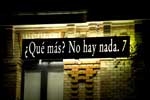
© Joseph Kosuth
"Al fin creí entender (Madrid)"
Fachada de La Casa Encendida (Madrid)
(Detalle)
Cortesía La Casa Encendida
"Al fin creí entender (Madrid)"
Fachada de La Casa Encendida (Madrid)
(Detalle)
Cortesía La Casa Encendida
Idioma: English
nexo5.com
The artist Joseph Kosuth creates an installation on the façade of La Casa Encendida
La Casa Encendida plays host to the first public installation by US artist Joseph Kosuth ever shown in Madrid, entitled 'Al Fin Creí Entender (Madrid)'. Curated by Christian Domínguez and a continuation of Kosuth's great installations around the world, the project is also the beginning of a new and possibly ongoing series of works. This specific project, specially created for the occasion, consists of the installation of a series of luminous texts taken from works by the Latin American authors Jorge Luis Borges, Julio Cortázar and Juan Carlos Onetti.
In addition to the installation on the façade, Joseph Kosuth also presents the project 'Located Work (Madrid)', created in collaboration with the artists Mario Aguirre, Alexander Apóstol, Busto Bocanegra, Sandra Gamarra, Hisae Ikenaga and Ximena Labra. In this project, Kosuth invites each artist to devise a work for one of the other participating artists to make. To complete the exchange of ideas, the artists have explained the construction of a work they wished to be fabricated through the project they devised and through the project made following the instructions received.
Joseph Kosuth in discussing his works in Madrid has said: "There are various aspects around this double location of being in two social, cultural and political spaces at once which interest me. The idea of being joined linguistically with Spain as well as culturally, however partially, yet continually feeling a 'difference' as part of one's cultural texture is part of the material of my work at the Casa, both outside on the facade and inside in the project with younger artists in the 'Located Work (Madrid)' project'.
"For the work on the facade I chose three authors, but not just any three authors, who were located inside the Spanish language but outside of Spain. What I have done is to use, as ready-made elements, fragments in the form of sentences taken from the three novels, by Borges (blue numbers), Cortázar (violet numbers) and Onetti (yellow numbers), to construct a fourth text which produces its own independent meaning. That meaning, which forms a text which is my work, constructs a narrative about its own making. If you know my work then you know how this works within it. The textual elements I have borrowed are ones with an established meaning within the writing of that author, yet, to do that they construct an atmosphere within that text which provides a quality which I then utilize'.
"What this work asks of the reader is to put into question meanings which are given (Who is speaking and to what purpose? What is the context words seek for their own self-knowledge?) and, finally, how is it we 'understand'? In the sense that the meanings of words are greatly formed by each other to construct the meaning of a sentence, those sentences function similarly in relation to each other to form a paragraph. It's not as simple as that, but for our purpose here it says enough. My construction, at the paragraph level, permits other tensions which are a product of being a bouquet of meanings, coming from both the literary 'coloration' of Borges, Cortázar and Onetti and that 'hyper-meaning' of mine which is experienced as it is constructed while you read. A literary texture is the result of the tension of the conflict between prior meaning and meaning in the present. This is why each sentence stands literally physically on its own, with my order and the original author identified and in play with/against each other. This 'play', as I call it, is a play within the signifying meaning system of art. And, for those who might wonder, there are historic precedents which establish this as a work of art, both within my work and outside of it. It uses literature, but it isn't literature. One can eat lunch off of a work of art which is a table, but (hah!) being a table isn't all of what it means'.
"One cannot presume to ignore the street viewer/reader's half of the social contract of which a cultural dialogue partakes. The challenge for me has been to find a way to do this while, at the same time, not compromise other aspects of my problematic as an artist. So one begins with the expectations associated with that 'house of experimentation', which of course necessitates that the work should add to our understanding of art. That is what I find so interesting about working on facades, particularly in a case such as La Casa Encendida; in a sense my work has a double cultural life'.
Concerning his collaboration with the artists Mario Aguirre, Alexander Apóstol, Busto Bocanegra, Sandra Gamarra, Hisae Ikenaga and Ximena Labra, Joseph Kosuth has stated: "The first question of this project is: where is the work located? I thought it would be instructive to separate two aspects of art making which are always experienced as being together as one thing -- the making of the work and the conception of the work. By separating them one can see, first, the importance of our conceptions about what we do, although that doesn't necessarily mean that work always precedes a priori with one grand conception. Often, within the work process is a series of micro decisions that constructs the conceptual grid of the path of our thinking. This becomes relevant to the 'fabricator' part of our project. We can see how there are conceptual moments within the choices we make even as simple fabricators of the instructions of another artist. I think the works produced will show that the conceptual orientation, or prejudice even, of the fabricator will come out in this work which is intended to be just 'following orders''.
"The work also permits a reflexive stance in relation to language; the words we choose when we attempt to externalize our ideas are first recognizable to ourselves, accordingly, as they are effective toward what they should convey, but also these words relate to the fabricator; one makes interpretive choices when the transition happens between reading and the subsequent choices made based on what is read. The language between the writer of the 'instructions' and the fabricator both joins them as it constructs a distorting wall of separation. But here, in relation to language, what blocks also clarifies and articulates. The limits of language become part of what shows us the way'.
"Where do we draw the line at the subjective roles, choices of others? That asks interesting questions of its own! Even with an articulated distribution of function accounted for, who signs their name? Yes, it could easily be seen as a work of mine, which is probably the least interesting approach in this case. It is also an inter-connective show of emerging artists. If so, or when so, it is a different kind of show than such shows are usually because we are permitted to see and experience from a variety of directions how these artists think. We 'bare the device' of the process of making art. I think that's always a good thing'.
About Joseph Kosuth
Joseph Kosuth (Toledo, Ohio, 1945) is one of the pioneers of conceptual and installation art. His works are based on the language of initiation and appropriation strategies of the 1960s. Through his work, Kosuth has systematically explored the production and role of language and meaning in art. His investigations into the relationship between art and language, conducted over a period of more than 40 years, have taken the form of installations, museum exhibitions, public commissions and publications throughout Europe, America and Asia, including his participation at five editions of Documenta in Kassel and four editions of the Venice Biennial, where on one occasion he presented his work in the Hungarian Pavilion (1993). He has received a number of prizes and recognitions, including the following: Brandeis Award (1990), Frederick Weisman Award (1991), Menzione d'onore at the Venice Biennial (1993), and the distinction of Chevalier de l'Ordre des Arts et des Lettres, granted by the French Government (1993). In 1968 he received a grant from the Cassandra Foundation. In June 1999 the French Government issued a three-franc stamp commemorating his work in the city of Figeac. In February 2001 he was awarded an Honorary Degree in Philosophy and Letters by the Università di Bolognia. In 2001 his novel Purloined was published by Salon Verlag. In October 2003 he was awarded Austria's highest distinction, the Decoration of Honour in Gold for services to the Republic of Austria, in recognition of his achievements in relation to science and culture.
La Casa Encendida plays host to the first public installation by US artist Joseph Kosuth ever shown in Madrid, entitled 'Al Fin Creí Entender (Madrid)'. Curated by Christian Domínguez and a continuation of Kosuth's great installations around the world, the project is also the beginning of a new and possibly ongoing series of works. This specific project, specially created for the occasion, consists of the installation of a series of luminous texts taken from works by the Latin American authors Jorge Luis Borges, Julio Cortázar and Juan Carlos Onetti.
In addition to the installation on the façade, Joseph Kosuth also presents the project 'Located Work (Madrid)', created in collaboration with the artists Mario Aguirre, Alexander Apóstol, Busto Bocanegra, Sandra Gamarra, Hisae Ikenaga and Ximena Labra. In this project, Kosuth invites each artist to devise a work for one of the other participating artists to make. To complete the exchange of ideas, the artists have explained the construction of a work they wished to be fabricated through the project they devised and through the project made following the instructions received.
Joseph Kosuth in discussing his works in Madrid has said: "There are various aspects around this double location of being in two social, cultural and political spaces at once which interest me. The idea of being joined linguistically with Spain as well as culturally, however partially, yet continually feeling a 'difference' as part of one's cultural texture is part of the material of my work at the Casa, both outside on the facade and inside in the project with younger artists in the 'Located Work (Madrid)' project'.
"For the work on the facade I chose three authors, but not just any three authors, who were located inside the Spanish language but outside of Spain. What I have done is to use, as ready-made elements, fragments in the form of sentences taken from the three novels, by Borges (blue numbers), Cortázar (violet numbers) and Onetti (yellow numbers), to construct a fourth text which produces its own independent meaning. That meaning, which forms a text which is my work, constructs a narrative about its own making. If you know my work then you know how this works within it. The textual elements I have borrowed are ones with an established meaning within the writing of that author, yet, to do that they construct an atmosphere within that text which provides a quality which I then utilize'.
"What this work asks of the reader is to put into question meanings which are given (Who is speaking and to what purpose? What is the context words seek for their own self-knowledge?) and, finally, how is it we 'understand'? In the sense that the meanings of words are greatly formed by each other to construct the meaning of a sentence, those sentences function similarly in relation to each other to form a paragraph. It's not as simple as that, but for our purpose here it says enough. My construction, at the paragraph level, permits other tensions which are a product of being a bouquet of meanings, coming from both the literary 'coloration' of Borges, Cortázar and Onetti and that 'hyper-meaning' of mine which is experienced as it is constructed while you read. A literary texture is the result of the tension of the conflict between prior meaning and meaning in the present. This is why each sentence stands literally physically on its own, with my order and the original author identified and in play with/against each other. This 'play', as I call it, is a play within the signifying meaning system of art. And, for those who might wonder, there are historic precedents which establish this as a work of art, both within my work and outside of it. It uses literature, but it isn't literature. One can eat lunch off of a work of art which is a table, but (hah!) being a table isn't all of what it means'.
"One cannot presume to ignore the street viewer/reader's half of the social contract of which a cultural dialogue partakes. The challenge for me has been to find a way to do this while, at the same time, not compromise other aspects of my problematic as an artist. So one begins with the expectations associated with that 'house of experimentation', which of course necessitates that the work should add to our understanding of art. That is what I find so interesting about working on facades, particularly in a case such as La Casa Encendida; in a sense my work has a double cultural life'.
Concerning his collaboration with the artists Mario Aguirre, Alexander Apóstol, Busto Bocanegra, Sandra Gamarra, Hisae Ikenaga and Ximena Labra, Joseph Kosuth has stated: "The first question of this project is: where is the work located? I thought it would be instructive to separate two aspects of art making which are always experienced as being together as one thing -- the making of the work and the conception of the work. By separating them one can see, first, the importance of our conceptions about what we do, although that doesn't necessarily mean that work always precedes a priori with one grand conception. Often, within the work process is a series of micro decisions that constructs the conceptual grid of the path of our thinking. This becomes relevant to the 'fabricator' part of our project. We can see how there are conceptual moments within the choices we make even as simple fabricators of the instructions of another artist. I think the works produced will show that the conceptual orientation, or prejudice even, of the fabricator will come out in this work which is intended to be just 'following orders''.
"The work also permits a reflexive stance in relation to language; the words we choose when we attempt to externalize our ideas are first recognizable to ourselves, accordingly, as they are effective toward what they should convey, but also these words relate to the fabricator; one makes interpretive choices when the transition happens between reading and the subsequent choices made based on what is read. The language between the writer of the 'instructions' and the fabricator both joins them as it constructs a distorting wall of separation. But here, in relation to language, what blocks also clarifies and articulates. The limits of language become part of what shows us the way'.
"Where do we draw the line at the subjective roles, choices of others? That asks interesting questions of its own! Even with an articulated distribution of function accounted for, who signs their name? Yes, it could easily be seen as a work of mine, which is probably the least interesting approach in this case. It is also an inter-connective show of emerging artists. If so, or when so, it is a different kind of show than such shows are usually because we are permitted to see and experience from a variety of directions how these artists think. We 'bare the device' of the process of making art. I think that's always a good thing'.
About Joseph Kosuth
Joseph Kosuth (Toledo, Ohio, 1945) is one of the pioneers of conceptual and installation art. His works are based on the language of initiation and appropriation strategies of the 1960s. Through his work, Kosuth has systematically explored the production and role of language and meaning in art. His investigations into the relationship between art and language, conducted over a period of more than 40 years, have taken the form of installations, museum exhibitions, public commissions and publications throughout Europe, America and Asia, including his participation at five editions of Documenta in Kassel and four editions of the Venice Biennial, where on one occasion he presented his work in the Hungarian Pavilion (1993). He has received a number of prizes and recognitions, including the following: Brandeis Award (1990), Frederick Weisman Award (1991), Menzione d'onore at the Venice Biennial (1993), and the distinction of Chevalier de l'Ordre des Arts et des Lettres, granted by the French Government (1993). In 1968 he received a grant from the Cassandra Foundation. In June 1999 the French Government issued a three-franc stamp commemorating his work in the city of Figeac. In February 2001 he was awarded an Honorary Degree in Philosophy and Letters by the Università di Bolognia. In 2001 his novel Purloined was published by Salon Verlag. In October 2003 he was awarded Austria's highest distinction, the Decoration of Honour in Gold for services to the Republic of Austria, in recognition of his achievements in relation to science and culture.
NOTICIA ORIGINAL
ÚLTIMAS NOTICIAS EN PORTADA


MANTENIDO POR

© nexo5.com :: All rights reserved :: Since Sep 20, 2006 -