Magacín digital de cultura contemporánea
AÑO 21 - Jueves, 8 de Octubre de 2026 a las 13:29:48 - Madrid (Spain-Europe)
TRADUCCIÓN
Carlos Correia at Fúcares Gallery of Almagro
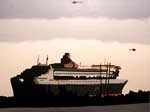
© Carlos Correia.
S/T (Queen 002), 2007.
Acrílico sobre lienzo.
97 x 130cm
S/T (Queen 002), 2007.
Acrílico sobre lienzo.
97 x 130cm
Idioma: English
nexo5.com
In his first solo exhibition in Spain, Carlos Correia exhibits new paintings and drawings. Some of his new works are part of series that he began in the past (Goya and Manet's executions, aeroplanes, portraits of the G8, photographers and interiors), while others are being shown for the first time (Space Shuttle, Robert Capa, Apocalypse Now, Matrix, Who's Josephine?).
Carlos Correia usually works on series, adapting the technique, medium, size, and, it could even be said, "style" when necessary. Accordingly, there is a constant tension between the questions that arise from the motif he depicts and the form in which he depicts (and presents) this motif. Because he works on more than one series at a time, it cannot be said that he is tied to a so-called "period" or "phase".
A fundamental rupture can be perceived within the overall series: the abyss between his 'exterior paintings' and the 'interior paintings'. It could be said that the 'exterior paintings' are based on pre-existing images, in contrast to the 'interior paintings', which were conceived to create a poetic discourse and therefore carry no reference to the visible world.
In his 'exterior paintings', the artist explores a whole range of interests and concerns. Some of these are inherent in the task of painting itself, while others spring from a very particular observation of the world. The reference to works of art from the not-too-distant past is a recurrent mechanism used by Correia. Just like the universe, the world of creative culture has also been transformed into a fragmentary being, where different models challenge and compete with one another, giving rise to a geometry that does not comply with Euclid's knowledge theories. In Neo-Baroque: A Sign of the Times, Omar Calabrese speaks about the distortion of the space of representation, as it would appear that this is now influenced by forces that treat it as if it were an elastic space. References to other works of art within a new work can be understood as one of the mechanisms of this distortion. Carlos Correia's concern in this respect is the possibility of rewriting history, and particularly the history of art, but not only that. As the aforementioned author has rightly pointed out: "(...) there are many ways of taking us back to the past: the historical that reconstructs, the critical that interprets, the informative that explains and all of these at the same time. The artist, however, goes one step further: he "renews" the past (...)". And how is this "renewal" achieved? According to Correia, by bringing the content of the past and the content of the present face-to-face, thus bringing about a "movement". Movement in two directions: from the past to the present and vice versa. When this happens, this movement doubles the space of representation. The present can therefore be described as the temporary axis on which everything revolves.
We can have access to everything and everything in the same measure (at least we have access to pictures of everything). The now hardly differs from the rest of history, except in that it is the only thing that has not yet happened. The speed with which we now receive facts and news causes us to doubt whether these events will go down in history. The resoluteness with which Correia returns to Manet's The Execution of Maximilian has one of its reasons for being grounded in this very doubt. As we all know, Manet used pictures and information from the newspapers to paint this painting, which was consequently painted "live", that is to say, before time relegated it to history.
However, this passion for tradition is not an indication that the artist is trapped in nostalgia because, for Correia, the reference to history only takes on full meaning when it is contrasted with the present.
The confrontation between reality and fiction through pictures borrowed from cinema and literature (which is the case with the Who´s Josephine series, where the artist embarks on a search for the face of the main female character for one of his tales) is another characteristic deserving of attention.
From the exhibition perspective, the assembly of the works is of vital importance to the artist. It is Carlos Correia's intention that the assembly bring together and confront disperse realities, from both a symbolic and material perspective, in an endeavour to adopt (and translate) the idea of montage, which was initially analysed by S. M. Eisenstein. Although the artist realises that 'montage as a process of signification' is a practice normally associated more with moving pictures than painting, he is aiming to bring about a re-reading of the assumptions theorised and practiced by Eisenstein, taking into account the changes that need to be made when moving from a cinematographic language to a pictorial language.
Preserving the singularities of each work is an ever-present concern in Correia's work process because, to use the words of John Rajchman, "connecting these "singularities" in a "consistent plane" can only take place when each one exists as a singular piece of work".
CARLOS CORREIA, 2008
Carlos Correia usually works on series, adapting the technique, medium, size, and, it could even be said, "style" when necessary. Accordingly, there is a constant tension between the questions that arise from the motif he depicts and the form in which he depicts (and presents) this motif. Because he works on more than one series at a time, it cannot be said that he is tied to a so-called "period" or "phase".
A fundamental rupture can be perceived within the overall series: the abyss between his 'exterior paintings' and the 'interior paintings'. It could be said that the 'exterior paintings' are based on pre-existing images, in contrast to the 'interior paintings', which were conceived to create a poetic discourse and therefore carry no reference to the visible world.
In his 'exterior paintings', the artist explores a whole range of interests and concerns. Some of these are inherent in the task of painting itself, while others spring from a very particular observation of the world. The reference to works of art from the not-too-distant past is a recurrent mechanism used by Correia. Just like the universe, the world of creative culture has also been transformed into a fragmentary being, where different models challenge and compete with one another, giving rise to a geometry that does not comply with Euclid's knowledge theories. In Neo-Baroque: A Sign of the Times, Omar Calabrese speaks about the distortion of the space of representation, as it would appear that this is now influenced by forces that treat it as if it were an elastic space. References to other works of art within a new work can be understood as one of the mechanisms of this distortion. Carlos Correia's concern in this respect is the possibility of rewriting history, and particularly the history of art, but not only that. As the aforementioned author has rightly pointed out: "(...) there are many ways of taking us back to the past: the historical that reconstructs, the critical that interprets, the informative that explains and all of these at the same time. The artist, however, goes one step further: he "renews" the past (...)". And how is this "renewal" achieved? According to Correia, by bringing the content of the past and the content of the present face-to-face, thus bringing about a "movement". Movement in two directions: from the past to the present and vice versa. When this happens, this movement doubles the space of representation. The present can therefore be described as the temporary axis on which everything revolves.
We can have access to everything and everything in the same measure (at least we have access to pictures of everything). The now hardly differs from the rest of history, except in that it is the only thing that has not yet happened. The speed with which we now receive facts and news causes us to doubt whether these events will go down in history. The resoluteness with which Correia returns to Manet's The Execution of Maximilian has one of its reasons for being grounded in this very doubt. As we all know, Manet used pictures and information from the newspapers to paint this painting, which was consequently painted "live", that is to say, before time relegated it to history.
However, this passion for tradition is not an indication that the artist is trapped in nostalgia because, for Correia, the reference to history only takes on full meaning when it is contrasted with the present.
The confrontation between reality and fiction through pictures borrowed from cinema and literature (which is the case with the Who´s Josephine series, where the artist embarks on a search for the face of the main female character for one of his tales) is another characteristic deserving of attention.
From the exhibition perspective, the assembly of the works is of vital importance to the artist. It is Carlos Correia's intention that the assembly bring together and confront disperse realities, from both a symbolic and material perspective, in an endeavour to adopt (and translate) the idea of montage, which was initially analysed by S. M. Eisenstein. Although the artist realises that 'montage as a process of signification' is a practice normally associated more with moving pictures than painting, he is aiming to bring about a re-reading of the assumptions theorised and practiced by Eisenstein, taking into account the changes that need to be made when moving from a cinematographic language to a pictorial language.
Preserving the singularities of each work is an ever-present concern in Correia's work process because, to use the words of John Rajchman, "connecting these "singularities" in a "consistent plane" can only take place when each one exists as a singular piece of work".
CARLOS CORREIA, 2008
NOTICIA ORIGINAL
ÚLTIMAS NOTICIAS EN PORTADA


MANTENIDO POR

© nexo5.com :: All rights reserved :: Since Sep 20, 2006 -