Magacín digital de cultura contemporánea
AÑO 21 - Jueves, 22 de Octubre de 2026 a las 03:38:51 - Madrid (Spain-Europe)
TRADUCCIÓN
MAXImin. The maximum expression of the minimal Art in more than 100 works by 82 artists
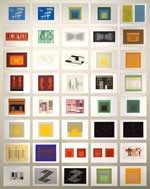
© Josef Albers (1888-1976)
Formulation: Articulation
(Formulación: articulación), 1972
Selección de una carpeta de 127 serigrafías.
Cortesía Fundación Juan March
Formulation: Articulation
(Formulación: articulación), 1972
Selección de una carpeta de 127 serigrafías.
Cortesía Fundación Juan March
Idioma: English
nexo5.com
With an exhibition title that has its origin in modern theories of rational choice and games, MAXImin is comprised of more than 110 works by 82 artists, and is the result of a collaboration between the Daimler Art Collection, Stuttgart, and the Fundación Juan March, Madrid. The exhibition, conceived by both institutions, seeks to present to the public a methodical history focusing on minimalist art trends over the past century within both the context of their abstract predecessors and their contemporary interpretations. Thus, it is a history seen from the perspective of the mutual "method" they share: that of maximum minimization.
The exhibition presents the formally "minimalized" approaches of certain artistic trends of the 1960s and '70s in a much larger context. To the extent that it contemplates these trends from a more methodical rather than thematic perspective, "Minimalism" no longer refers to a solely American movement of the 1960s, but emerges as a tendency shared by the work of artists from highly diverse eras and places. Thus, the exhibition is comprised of works that include the distant ancestors of Minimalism in Central European Abstract Painting of the early 20th century - especially in southern Germany - as well as those who have incorporated Abstract and Minimal Art trends and traditions throughout the century and into the present day on four continents.
Before and After Minimalism: A Century of Abstract Tendencies in the DaimlerChrysler Collection
The artistic current known as Minimal Art and especially the installations and objects of the representatives of classical 1960s Minimalism - artists such as Carl Andre, Dan Flavin, Donald Judd and the recently deceased Sol LeWitt - have made such an impact on the genre that it is often perceived as an autochthonous and purely North American phenomenon. That said, beyond the circumstance of its American birth, perhaps Minimalism does not consist so much in a thematic current but, more likely, in a kind of pluralism that is based, above all, on abstraction, constructivism and formal reduction.
Distinct from other modern and contemporary art collections with more general objectives with regard to their representation of art, the DaimlerChrysler Collection, as of 1977, took advantage of the presence of Daimler-Benz AG in Stuttgart - although it also has headquarters and plants worldwide - and focused their collecting on the origins of abstraction. They focused on the Stuttgart Academy and Hölzel, a true pioneer of abstract art, whose teachings would later influence the professors of the Bauhaus. With selective criteria and growing internationalization, the collection, comprised of approximately 1,500 works by some 400 artists, has continued to expand its holdings of art by the Abstract-Constructivists, Conceptualists and Minimalists.
The exhibition presents the formally "minimalized" approaches of certain artistic trends of the 1960s and '70s in a much larger context. To the extent that it contemplates these trends from a more methodical rather than thematic perspective, "Minimalism" no longer refers to a solely American movement of the 1960s, but emerges as a tendency shared by the work of artists from highly diverse eras and places. Thus, the exhibition is comprised of works that include the distant ancestors of Minimalism in Central European Abstract Painting of the early 20th century - especially in southern Germany - as well as those who have incorporated Abstract and Minimal Art trends and traditions throughout the century and into the present day on four continents.
Before and After Minimalism: A Century of Abstract Tendencies in the DaimlerChrysler Collection
The artistic current known as Minimal Art and especially the installations and objects of the representatives of classical 1960s Minimalism - artists such as Carl Andre, Dan Flavin, Donald Judd and the recently deceased Sol LeWitt - have made such an impact on the genre that it is often perceived as an autochthonous and purely North American phenomenon. That said, beyond the circumstance of its American birth, perhaps Minimalism does not consist so much in a thematic current but, more likely, in a kind of pluralism that is based, above all, on abstraction, constructivism and formal reduction.
Distinct from other modern and contemporary art collections with more general objectives with regard to their representation of art, the DaimlerChrysler Collection, as of 1977, took advantage of the presence of Daimler-Benz AG in Stuttgart - although it also has headquarters and plants worldwide - and focused their collecting on the origins of abstraction. They focused on the Stuttgart Academy and Hölzel, a true pioneer of abstract art, whose teachings would later influence the professors of the Bauhaus. With selective criteria and growing internationalization, the collection, comprised of approximately 1,500 works by some 400 artists, has continued to expand its holdings of art by the Abstract-Constructivists, Conceptualists and Minimalists.
NOTICIA ORIGINAL
ÚLTIMAS NOTICIAS EN PORTADA


MANTENIDO POR

© nexo5.com :: All rights reserved :: Since Sep 20, 2006 -