Magacín digital de cultura contemporánea
AÑO 20 - Martes, 18 de Agosto de 2026 a las 17:47:20 - Madrid (Spain-Europe)
TRADUCCIÓN
Zhu Ming. Light boxes and photographs
© Zhu Ming
Cortesía Estiarte
Cortesía Estiarte
Idioma: English
nexo5.com
Estiarte presents the work of chinese artist Zhu Ming, one of the most representative figures on the current scene of contemporary oriental art.
The work of Zhu Ming (Changsha, Hunan, China, 1972) is based on a nihilistic consideration of reality and existence. His performances explore concepts such as protection, vulnerability and interdependence referring to the construction of personal identity, as well as its relation with the passing of time, in a subjecting of his own body to extreme situations in order to show the ephemeral nature of life in works that involve taking his own body to a limit state.
In 1991 he moved to Beijing where he started his work linked to a group of artist that lived in the East Village of that city at the beginning of the '90s and which arose as a consequence of the social and economic transformations undergone in China starting in 1992. He took part in the first actions of the Dong Cun work group together with Zhang Huang and Ma Liuming, who practice a conceptualism close to the body art projected in extreme body performances using photography to fix these events.
Up to the beginning of the nineties, Chinese photography took the form of a tool for filing and a method of recording of actions and installations. Both Zhu Ming and the rest of his generational peers took advantage of the experimental nature of photography considering its own language and its independent artistic specificity. Moreover, and owing to the emerging introduction of these artists onto the international market, photography became the major vehicle for their works.
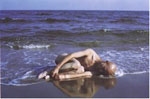
In the evolution of Zhu Ming's work, the use of soap for washing his own clothes was the inspiring force for his performances in the early nineties. The bubbles produced by his own breathing, which cover or inundate him, are as beautiful as they are individualistic and as fragile as modern-day art is evanescent. In 1998 he worked with condoms filled with liquids and at the end of the decade he started his actions with enormous plastic balls. With himself inside them, Zhu Ming explored his own individuality through their location in public places, woods or in the middle of the sea, endangering his own life by exposing himself to extreme conditions for hours on end. In 2001, the difficulty of achieving good photographs of his actions in interiors led him to working with fluorescent ink, converting his body into a hollow container, into a bubble about to burst, to disappear for ever.
Zhu Ming says: "The brain is the part of my body where my works really come from without the conditioning factor of outside reality. It is the simplest world in which I can work with total and absolute freedom. Thinking is free, acting is relative. The spiritual world is a diffuse intersection between life and art. The meaning of my work is in revealing reality. The spiritual world is shown through materials and acts. I would like to act in a way that is extremely unaware. I believe that I was born to do what I am doing. An artist must, above all else, be very human. I have my own principles of what it means to be human establishing certain limits. This is what is known as the contradiction of being. I hold on to the dream of belonging to a group of people in order to do what we are, intensely together, simply, without the conflicts that can reduce this idea to just a dream. Moreover, I believe that this can be easier when there is not too much desire. I'm radical. I'm radical as far as art is concerned, which means that I will live a life that is not just full but also complex and hopeful."
Zhu Ming held his performances and displayed his work individually in the Victoria and Albert Museum of London in 2006 and in the Contemporary Museum of Sydney in Australia in 2003. In 2007 he took part in the exhibition Zhu Yi! Chinese Contemporary Photography, in ARTIUM in Álava, Spain, and in the Victoria and Albert Museum of London. In 2005 he participated in the Venice Biennial.
The work of Zhu Ming (Changsha, Hunan, China, 1972) is based on a nihilistic consideration of reality and existence. His performances explore concepts such as protection, vulnerability and interdependence referring to the construction of personal identity, as well as its relation with the passing of time, in a subjecting of his own body to extreme situations in order to show the ephemeral nature of life in works that involve taking his own body to a limit state.
In 1991 he moved to Beijing where he started his work linked to a group of artist that lived in the East Village of that city at the beginning of the '90s and which arose as a consequence of the social and economic transformations undergone in China starting in 1992. He took part in the first actions of the Dong Cun work group together with Zhang Huang and Ma Liuming, who practice a conceptualism close to the body art projected in extreme body performances using photography to fix these events.
Up to the beginning of the nineties, Chinese photography took the form of a tool for filing and a method of recording of actions and installations. Both Zhu Ming and the rest of his generational peers took advantage of the experimental nature of photography considering its own language and its independent artistic specificity. Moreover, and owing to the emerging introduction of these artists onto the international market, photography became the major vehicle for their works.
In the evolution of Zhu Ming's work, the use of soap for washing his own clothes was the inspiring force for his performances in the early nineties. The bubbles produced by his own breathing, which cover or inundate him, are as beautiful as they are individualistic and as fragile as modern-day art is evanescent. In 1998 he worked with condoms filled with liquids and at the end of the decade he started his actions with enormous plastic balls. With himself inside them, Zhu Ming explored his own individuality through their location in public places, woods or in the middle of the sea, endangering his own life by exposing himself to extreme conditions for hours on end. In 2001, the difficulty of achieving good photographs of his actions in interiors led him to working with fluorescent ink, converting his body into a hollow container, into a bubble about to burst, to disappear for ever.
Zhu Ming says: "The brain is the part of my body where my works really come from without the conditioning factor of outside reality. It is the simplest world in which I can work with total and absolute freedom. Thinking is free, acting is relative. The spiritual world is a diffuse intersection between life and art. The meaning of my work is in revealing reality. The spiritual world is shown through materials and acts. I would like to act in a way that is extremely unaware. I believe that I was born to do what I am doing. An artist must, above all else, be very human. I have my own principles of what it means to be human establishing certain limits. This is what is known as the contradiction of being. I hold on to the dream of belonging to a group of people in order to do what we are, intensely together, simply, without the conflicts that can reduce this idea to just a dream. Moreover, I believe that this can be easier when there is not too much desire. I'm radical. I'm radical as far as art is concerned, which means that I will live a life that is not just full but also complex and hopeful."
Zhu Ming held his performances and displayed his work individually in the Victoria and Albert Museum of London in 2006 and in the Contemporary Museum of Sydney in Australia in 2003. In 2007 he took part in the exhibition Zhu Yi! Chinese Contemporary Photography, in ARTIUM in Álava, Spain, and in the Victoria and Albert Museum of London. In 2005 he participated in the Venice Biennial.
NOTICIA ORIGINAL
ÚLTIMAS NOTICIAS EN PORTADA


MANTENIDO POR

© nexo5.com :: All rights reserved :: Since Sep 20, 2006 -